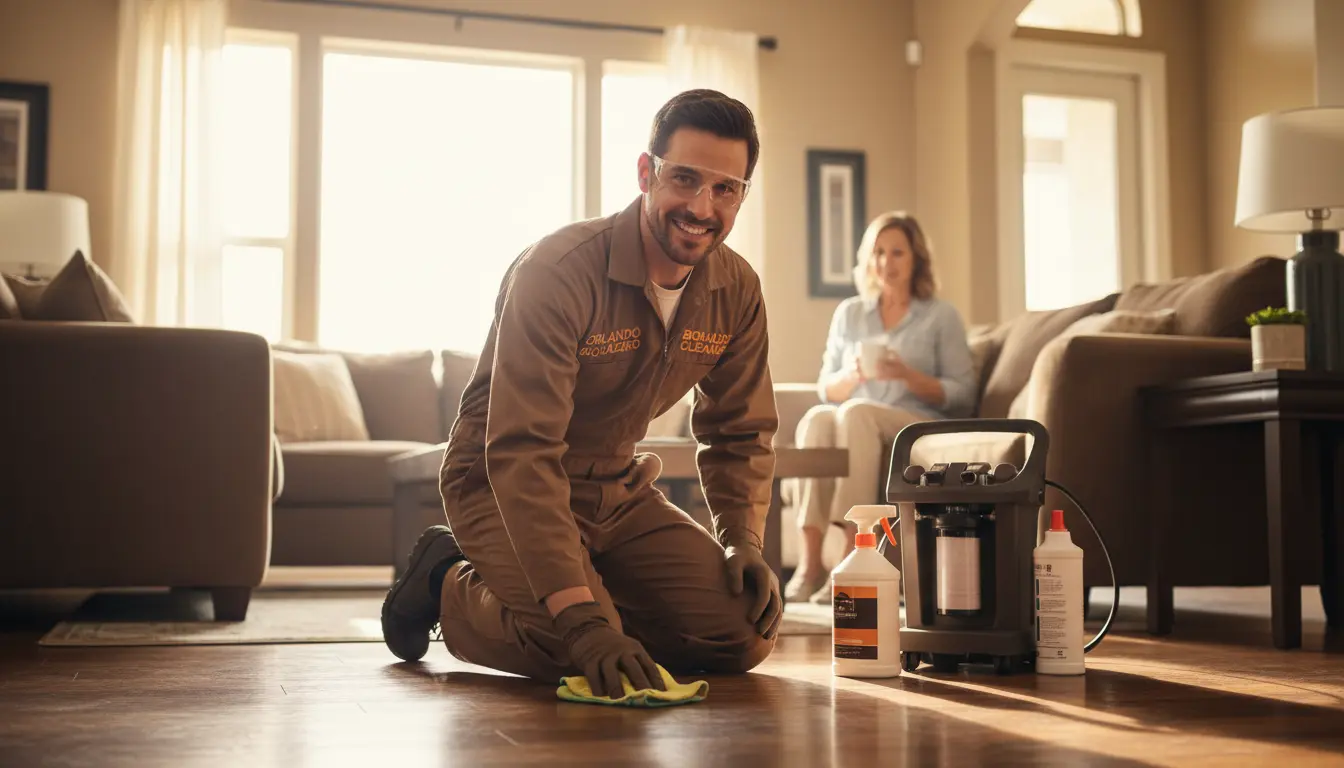
You might be paying thousands of dollars in unnecessary repairs and risking your family’s health right now if you’ve attempted to clean a biohazard scene yourself or hired a standard janitorial service. In communities like Dr. Phillips, Windermere, and the greater Orlando area, the combination of subtropical humidity and porous construction materials (common in Florida homes) turns biological spills and decomposition into a race against time. Without proper containment and antimicrobial treatment, bloodborne pathogens and bacteria can seep into drywall, under flooring, and into HVAC systems, leading to long-term contamination that standard cleaning products simply cannot neutralize.
Orlando Biohazard Cleanup understands the unique challenges of biohazard remediation in Central Florida. We are a locally owned, certified, and insured company specializing in trauma scene cleanup, unattended death cleanup, hoarding cleanup, and infectious waste disposal. Our technicians follow strict IICRC S540 and OSHA protocols to ensure every trace of biological hazard is removed, disposed of legally, and the property is restored to a safe, habitable condition. When you search for biohazard cleanup services near Dr. Phillips and nearby communities, you need a team that responds immediately, works discreetly, and understands both the science and the compassion required for these difficult situations.
Technical Process: How Professional Biohazard Remediation Works in Orlando’s Climate
Professional biohazard cleanup is far more involved than surface wiping. It begins with a comprehensive risk assessment. Our team arrives in full personal protective equipment (PPE) including Tyvek suits, N100 respirators, and nitrile gloves. We set up negative air machines to create a pressure gradient that prevents airborne contaminants from spreading to unaffected areas of the home or business. This is critical in Orlando’s humid environment, where moisture can accelerate the growth of mold and bacteria on organic residues.
The next step is removal of all biohazardous materials. This includes saturated carpet, padding, drywall, insulation, and any porous items that cannot be effectively decontaminated. We use hospital-grade, EPA-registered disinfectants with a contact time sufficient to inactivate pathogens such as hepatitis B, hepatitis C, HIV, and MRSA. After cleaning, we perform adenosine triphosphate (ATP) fluorescence testing to verify that all organic matter has been eliminated. This scientific measurement ensures the surface is truly clean, not just visually clean. Finally, we may apply antimicrobial sealants to encapsulate any remaining microscopic residue and neutralize odors using specialized enzyme treatments and ozone generators.
Data Comparison: Professional Remediation vs. Standard Janitorial Cleaning
| Feature / Metric | Professional Biohazard Remediation | Standard Residential Cleaning |
|---|---|---|
| Regulatory Compliance | OSHA 29 CFR 1910.1030, EPA guidelines, DOT transport regulations, IICRC S540 | None; no knowledge of bloodborne pathogen standards |
| Pathogen Elimination | EPA-registered disinfectants with verified contact times; ATP testing | Household bleach or all-purpose cleaners; no efficacy testing |
| Structural Assessment | Inspection for hidden saturation using moisture meters and thermal imaging | Visual inspection only; misses subfloor and wall cavity contamination |
| Waste Disposal | Segregation, labeling, and transport to licensed medical waste incinerators | Throws biohazard waste in regular trash, illegal and dangerous |
| Odor Elimination | Enzyme treatments, ozone, hydroxyl generators, HVAC sanitization | Air fresheners that mask odor; does not address source |
| Insurance Coordination | Detailed documentation and line-item reporting for claims | No documentation; may void insurance coverage |
Source: IICRC S540 Trauma and Crime Scene Cleanup Standard
Expert Insights: Three Diagnostic Tips for Property Owners
1. Hidden Biological Seepage Is Invisible
When blood or other bodily fluids pool, they can seep through carpet pad and into the subfloor, even traveling along floor joists. In Florida homes, where concrete slabs are common, fluids can wick up through porous concrete and into drywall. Our technicians use moisture meters and borescopes to detect this hidden contamination. If you only clean the surface, pathogens remain, and odors will return as humidity reactivates residue.
2. Porous Materials Almost Always Require Removal
Many property owners believe that cleaning a bloodstained carpet or drywall with bleach is sufficient. In reality, porous materials like drywall, carpet, padding, and unsealed wood cannot be fully decontaminated because pathogens become trapped in the material matrix. The IICRC S540 standard recommends removal of any porous material that has been saturated with biohazardous fluids. Replacing these materials is often cheaper and safer than attempting salvage.
3. Negative Pressure Is Non-Negotiable
Without negative air pressure, airborne particles from the biohazard site can travel through the HVAC system and contaminate the entire home. In Orlando’s high-humidity environment, this can also introduce mold spores. Our remediation process includes sealing off the work area and using HEPA-filtered negative air machines to contain and filter the air. This protects both the occupants and the rest of the property.
Common Mistakes Property Owners Make
One of the most frequent errors is using household bleach on biological matter. Bleach can actually fix proteins to surfaces, making them harder to remove and potentially inactivating only a fraction of pathogens. It also does not penetrate porous materials. The result is a surface that looks clean but remains contaminated. Another mistake is waiting for odors to dissipate naturally. Decomposition odors are caused by volatile organic compounds that persist and can be absorbed by furniture, drywall, and ductwork. Professional odor elimination is required to fully neutralize these compounds. Finally, allowing untrained family members or employees onto the site before professional remediation can expose them to bloodborne pathogens and create liability issues. Always secure the area and call a certified biohazard cleanup service immediately.
Pricing for Biohazard Cleanup Services Near Dr. Phillips
Pricing for biohazard remediation varies based on the scope and severity of the incident. Typical cost factors include:
- Site mobilization and assessment fee: A standard fee covers the arrival of the response team, initial evaluation, and setup of containment equipment. This usually ranges from $300 to $600 depending on location and time of day.
- Hourly remediation rates: Most services charge between $150 and $300 per hour per technician. The number of technicians and hours depends on the size of the affected area and the complexity of the cleanup.
- Specialized waste disposal: Biohazardous waste must be transported and incinerated at licensed facilities. Disposal costs can range from $200 to $1,000 or more based on volume and waste type.
Three primary factors influence the total cost: the extent of structural material replacement required (e.g., removing and replacing drywall, flooring, cabinets), the total volume of biohazardous waste, and the necessity for specialized HVAC decontamination if the contamination has spread through the ventilation system. Orlando Biohazard Cleanup provides transparent, itemized estimates before any work begins and works directly with your insurance company to simplify the claims process.
Safety & Standards: Certifications That Protect You
Our technicians are certified in accordance with OSHA’s Bloodborne Pathogens Standard (29 CFR 1910.1030) and follow the IICRC S540 standard for trauma and crime scene cleanup. We use only EPA-registered disinfectants and adhere to strict protocols for personal protective equipment, waste containment, and disposal. All biohazard waste is transported in leak-proof, labeled containers to authorized medical waste treatment facilities. This level of compliance protects not only our team but also property owners, occupants, and future residents from exposure to communicable diseases. In Orlando, where many homes have shared ventilation and close proximity to neighbors, proper containment is especially important to prevent community spread.
Frequently Asked Questions About Biohazard Remediation
What types of incidents require professional biohazard cleanup?
Any situation involving blood, bodily fluids, human or animal remains, infectious waste, or chemical hazards requires professional remediation. This includes trauma scenes (homicide, suicide, accident), unattended death, hoarding environments, meth lab decontamination, sewage backups, and medical waste spills. Standard cleaning services are not equipped or certified to handle these hazards, and attempting to do so can result in legal penalties and health risks.
How quickly should I call for biohazard cleanup after an incident?
Immediately. In Orlando’s warm and humid climate, biological decomposition accelerates rapidly. Within hours, odors can become overwhelming, and bacteria can multiply exponentially. Prompt response not only reduces the risk of cross-contamination but also minimizes structural damage and the cost of restoration. Orlando Biohazard Cleanup offers 24/7 emergency response to ensure that help arrives when you need it most.
Is biohazard cleanup covered by homeowners insurance?
Most homeowners and property insurance policies cover biohazard remediation, especially if it results from a covered event such as a death on the property, a crime, or a sewage backup. We provide detailed documentation, including photographs, testing results, and line-item invoices, to support your insurance claim. It is important to contact your insurance provider as soon as possible and to hire a certified remediation company to ensure compliance with policy requirements.
Can you clean up after a suicide or unattended death discreetly?
Yes. We understand the extreme emotional distress that accompanies these situations. Our team operates with the utmost compassion and discretion. We work in plain vehicles, avoid signage, and communicate directly with the family or property manager to minimize disruption. Our goal is to restore the property to a safe, clean state while respecting the privacy of all involved.
What happens to the biohazard waste after cleanup?
All biohazardous materials are properly segregated, packaged in red biohazard bags and containers, labeled according to DOT regulations, and transported to a licensed medical waste incinerator. We comply with all local, state, and federal regulations for the disposal of regulated medical waste. This ensures that pathogens are completely destroyed and that the waste does not enter the general waste stream.
Professional Biohazard Remediation in Orlando
When you face a biohazard situation in Dr. Phillips or any nearby community, you need a team that combines technical expertise with empathy and speed. Orlando Biohazard Cleanup is that team. We are locally owned, certified, and committed to restoring your property safely and thoroughly. Our technicians are trained in forensic restoration, microbial remediation, and cross-contamination prevention. We use advanced equipment and proven protocols to ensure every trace of biological hazard is eliminated. Don’t risk your health or your property by attempting to handle this alone. Contact us today for immediate, discreet, and professional biohazard cleanup services near Dr. Phillips and nearby communities.